Price Targets and the Measured Move
- Posted by Greg Harmon
- on September 2nd, 2011
Recently I received a question asking me how I create a Measured Move for some of the price targets on the Trade Ideas I share. I sometimes use Measured Move (MM) as a generic moniker for a price target but more properly it is used to approximate the next leg of a move based on an assumption that it will be of similar length as the previous one. Before I delve into the details it is important to know that this is a tool to approximate a potential move, not a hard and fast answer, and that as quickly as it is established the price can reverse and it becomes useless in the short term. With that in mind below are a few examples of how these are created with some live charts.
Consumer Staples Select Sector SPDR, $XLP
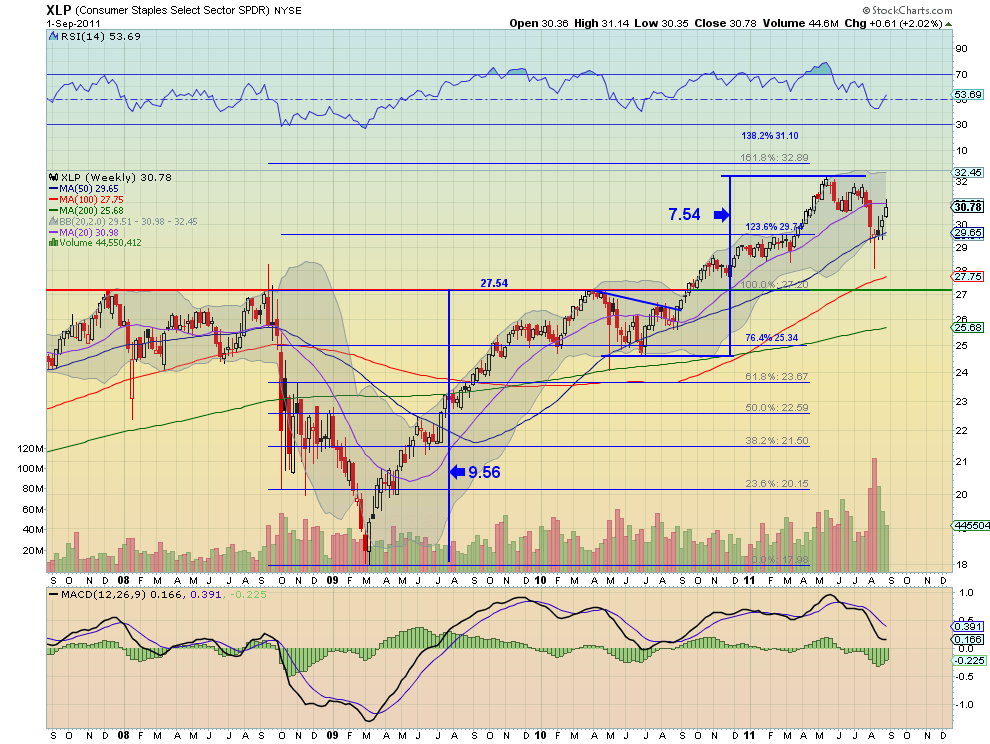
The weekly chart for the Consumer Staples Select Sector SPDR, $XLP, is a good one to start with. Notice that after bottoming at 17.98 in March 2009 it rose to 27.54 in April 2010 before pulling back. This 9.56 point move sets the target for the next move higher off of the pullback to 24.69 at 34.25. As you can see it did not reach that target rising only 7.54 points to 32.23. This brings up a good point. It is not a given that a Measured Move will be achieved. You must continue to watch price and all all your other indicators to exit profitably, but it does give a sense of the scope of a potential move.
iShares Barclays 20+ Year Treasury Bond Fund, $TLT
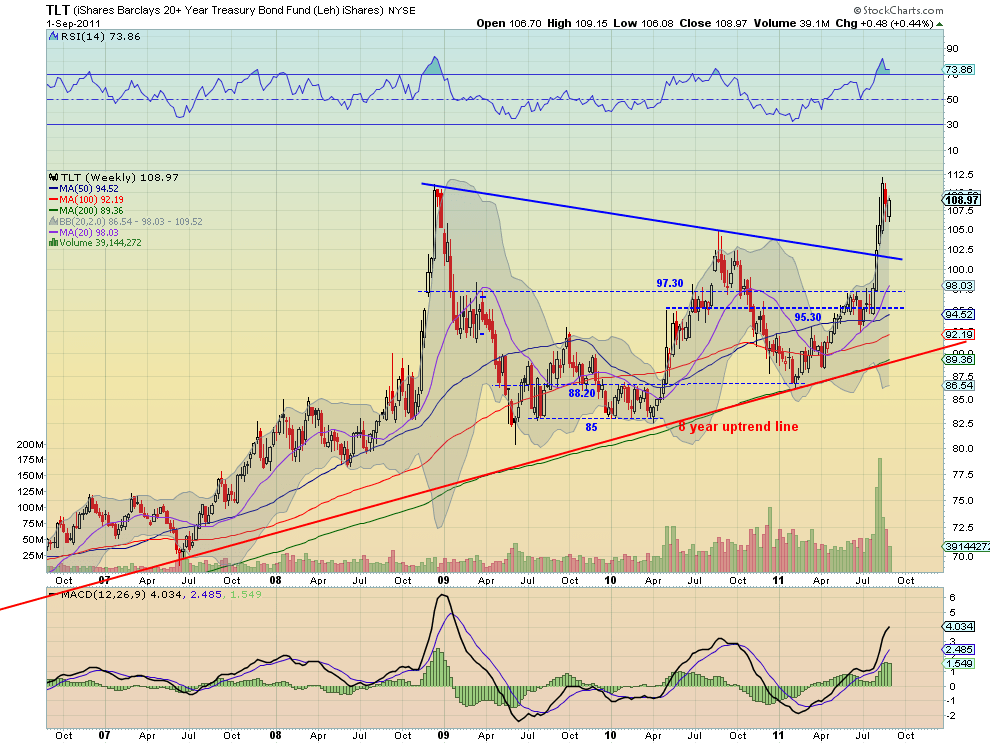
One that I have written about lately is the iShares Barclays 20+ Year Treasury Bond Fund, $TLT. It had been in a nearly 3 year symmetrical triangle before breaking out higher 5 weeks ago. I have written of the target on the pattern break at 137. This comes from adding the widest part of the pattern in the 4th Quarter of 2009 at 35 points to the break out level of 102. Technically this is not a Measured Move but rather a pattern target based on previous history of the pattern. But we can get a target for the next step higher by taking a Measured Move on the leg that broke through the pattern. The move from the 95.30 basing to the current consolidation near 108, or 12,7 points, added to the 108 level will give a next target on a Measured Move higher to 120.70 on the way to the pattern target. This looks like a good trade set up.
Apple, $AAPL
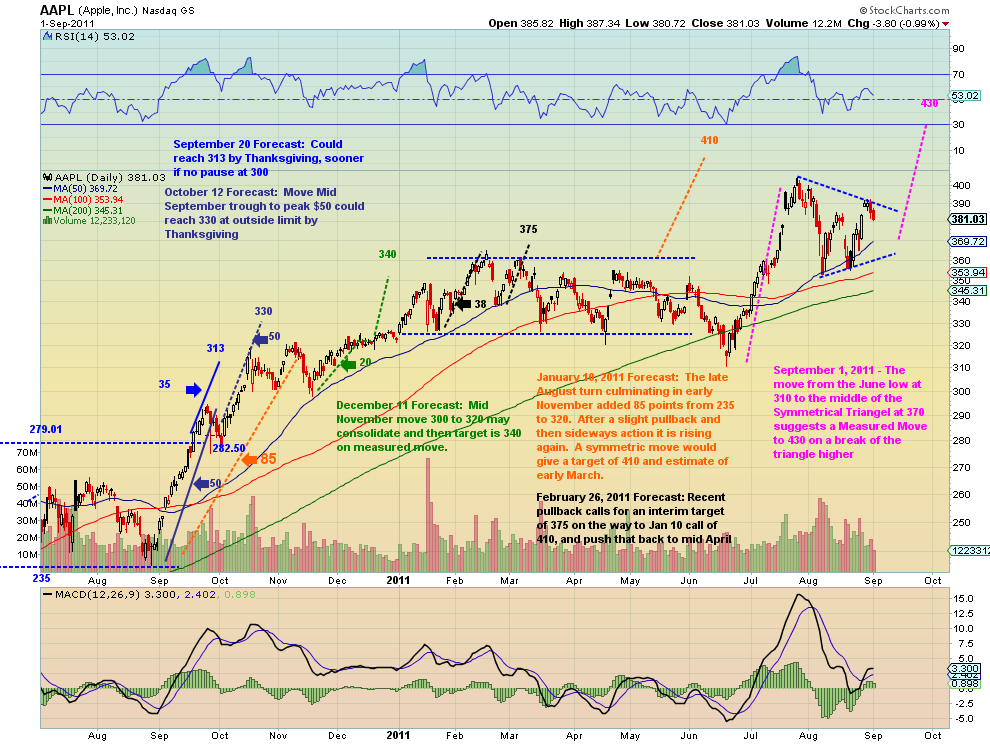
The final example, Apple, $AAPL, is a chart that I have used for over a year to measure upside potential. I will focus on the pink notation from September 1, 2011 but you can click on the chart to enlarge it and see how past measured moves have worked out. Moving off of the June low at 310 $AAPL transitioned into a Symmetrical Triangle in July with touches to both rails twice. The center of the triangle is around 370 so I would expect that a break above the triangle to continue higher to a Measured Move of 430 adding the previous 60 point move to the mid line. Some would say that the move from June was from 310 to 400 so you should add 90 and that is fine, but then you would add 90 to the launch point of 355 or if it pulls back to the bottom rail likely around 360 for a target of 445-450. All are a long way above where it is trading now.
As always you can see details of individual charts and more on my StockTwits feed and on chartly.)
If you like what you see above sign up for deeper analysis and trading strategy by using the Get Premium button above. As always you can see details of individual charts and more on my StockTwits page.
The information in this blog post represents my own opinions and does not contain a recommendation for any particular security or investment. I or my affiliates may hold positions or other interests in securities mentioned in the Blog, please see my Disclaimer page for my full disclaimer.
blog comments powered by Disqus
-
 Gregory W. Harmon CMT, CFA, has traded since 1986 and held senior positions including Head of Global Trading, Head of Product Development, Head of Strategy and Director of Equity. (More)
 -
Subscribe to Dragonfly Capital Views
Lifetime Subscription
$4,000.00Sign upAnnual Subscription
$1,000.00Sign upQuarterly Subscription
$350.00Sign up
Recent Posts
- Top Trade Ideas for the Week of October 12, 2026: The Rest Premium
- Top Trade Ideas for the Week of October 12, 2026: The Best
- SPY Trends and Influencers October 10, 2026
- Macro Week in Review/Preview October 9, 2026
- Bull Scan for 10-12-26
- How this Week’s Premium Top 10 Performed, October 9, 2026
- Bull Scan for 10-9-26
- Bull Scan for 10-8-26
- Bull Scan for 10-7-26
- Premium Earnings 10-6-26: Constellation Brands
Archives